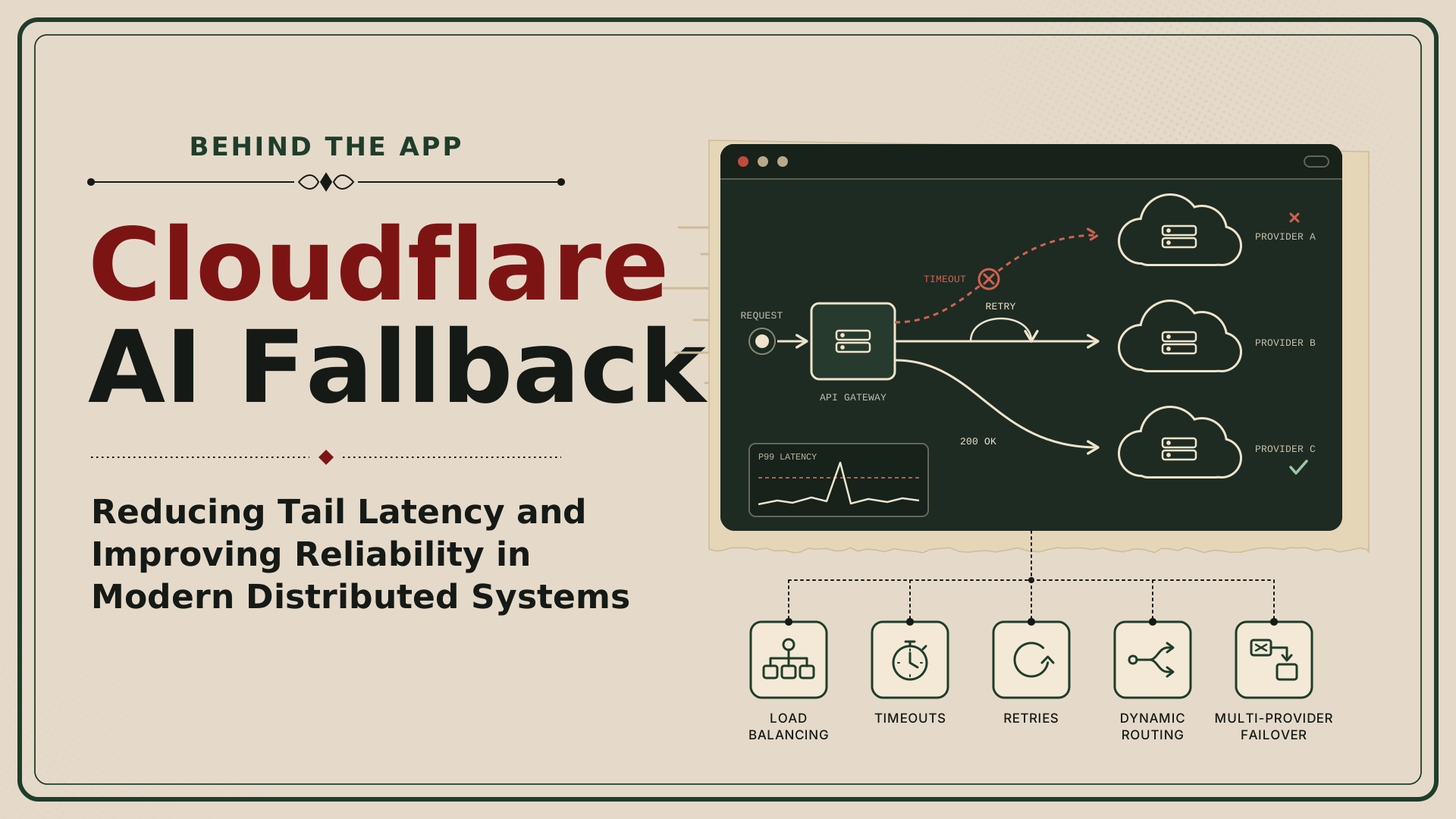
Modern AI applications have become distributed systems, whether their builders intended that outcome or not. A single user request commonly travels through authentication, an application server, an API gateway, one or more AI providers, a database or cache, and several networking layers before a response reaches the client. When every component is healthy the complexity stays hidden. The moment a primary provider slows, overloads, or returns errors, the hidden path turns into visible delay. Fallback mechanisms therefore matter for any application that cannot tolerate dependence on a single provider. The interesting problem is not merely the existence of a backup path. It is the decision of when to stop waiting for the primary and begin work on another route.
Cloudflare AI Gateway supplies a concrete industrial reference. Its documentation covers provider and model fallback, request timeouts, retries, and Dynamic Routing. Fallback can move a request to the next configured provider or model after an error or a timeout. Dynamic Routing adds conditional flows, model nodes that carry their own timeouts and retries, rate and budget limits, and explicit fallback edges. The gateway also exposes the cf-aig-step response header so an application can see which step ultimately succeeded. These features do not solve the research question by themselves, yet they demonstrate the control surface every multi-provider AI gateway eventually needs. The broader problem remains vendor-independent: any gateway sitting between clients and multiple inference endpoints must choose whether to wait, retry, switch, or launch a parallel request. A conservative choice leaves users staring at multi-second pauses even when a healthy secondary could have answered earlier. An aggressive choice multiplies inference cost and can overload the very backup that was meant to protect the system.
The Hidden Cost of Waiting for a Fallback
A common misconception is that fallback latency is dominated by the secondary provider’s inference time. In practice, the time spent deciding to invoke the fallback is often comparable to or larger. Consider a primary that normally finishes in a few hundred milliseconds but occasionally stalls. If the gateway waits five seconds before failing over, a secondary that responds in 300 ms still produces more than five seconds of user-visible delay. The simplified relation
total latency = primary wait time + fallback response timemakes the priority obvious: reduce the decision latency between detecting unhealthiness and starting the backup path.
AI APIs amplify the difficulty because response time is highly variable. Short prompts finish quickly while long contexts, tool-using agents, or high-token generations take substantially longer. Provider-side queueing shifts with traffic, and network jitter adds further noise unrelated to model compute. A fixed timeout must therefore balance two risks: waiting too long and exposing users to unnecessary tail latency, or acting too quickly and treating normal variation as failure.
Cloudflare’s request-handling documentation makes the timeout based on the arrival of the first part of the response. This is particularly relevant for streaming workloads: once the first tokens appear, the gateway continues waiting for the remainder. The distinction between an explicit error and a merely slow-but-successful response is crucial. An HTTP error is easy to act on immediately. A response that eventually succeeds after several seconds is harder to classify because it is technically correct yet may be unacceptable for the application’s latency budget. At that point, fallback begins to resemble a scheduling and prediction problem rather than simple error handling.
Why Tail Latency Matters More Than the Average
Average latency is a convenient summary, but it conceals the exact problem fallback is intended to solve. An application with a 350 ms average and a 4.5 s P99 feels responsive to most users, while a small fraction experience multi-second pauses. At scale, those pauses are numerous: one percent of ten million daily requests is still 100,000 slow interactions. Percentiles such as P50, P95, P99 and P99.9 therefore become the primary metrics for evaluating recovery behavior.
A strategy that raises average latency from 320 ms to 330 ms while cutting P99 from several seconds to under one second is often a clear win for interactive applications. Users notice the long pauses far more than small differences among already-fast requests. Streaming further complicates the picture. Time-to-first-token (TTFT) governs perceived responsiveness in chat interfaces, while total completion time matters for batch or offline workloads. A provider can excel at one and lag at the other. Consequently, a fallback policy tuned for conversational latency may differ from one tuned for complete generation.
What Cloudflare AI Gateway Illustrates
Cloudflare AI Gateway is useful not because it implements any particular adaptive algorithm, but because it exposes the levers required to study the problem. Its Universal endpoint (now largely superseded for new work by the OpenAI-compatible endpoint plus Dynamic Routing) accepts an ordered list of provider/model objects and advances on error or timeout. Dynamic Routing lets operators compose visual or JSON flows containing conditional nodes, percentage splits, rate and budget limits, and model nodes that each carry their own timeout, retry count, and optional fallback edge. Gateway-level retries (up to five attempts with constant, linear or exponential backoff) can be configured independently and are exhausted before a fallback edge fires. The cf-aig-step header reports which step produced the final response.
These controls make it possible to compare fixed sequential timeouts against more sophisticated policies without inventing an entire gateway from scratch. They also highlight the practical distinction between retry and fallback: retries stay on the same path and can amplify load on an already struggling provider; fallbacks move traffic elsewhere and can overload the secondary if many requests trip the same threshold simultaneously.
The Limits of Fixed Timeouts
A fixed timeout is the simplest and most predictable starting point. The gateway chooses a constant threshold and applies it uniformly. Requests that exceed the threshold move to the next step. The approach is easy to reason about and easy to test, which is why it serves as the natural baseline.
Its weakness is the assumption that a single number can separate healthy from unhealthy behavior across changing workloads. When normal latency ranges from 250 ms to 900 ms, a 500 ms timeout generates many false positives and therefore duplicate inference. When the timeout is set conservatively to five seconds, true degradations are allowed to linger far longer than necessary. The result is a permanent compromise between unnecessary cost and unacceptable tail latency. The ideal value for one traffic mix or model is unlikely to remain ideal as prompts, concurrency, and provider health evolve.
Adaptive Fallback: Context Instead of a Single Number
An adaptive policy replaces the constant threshold with statistics derived from recent observations. The gateway maintains a rolling window of latency percentiles (P50, P95, P99), error rate, timeout rate, and perhaps request volume or estimated utilization for each provider. The decision for the current request then becomes a comparison against that local distribution rather than against a global constant.
A request that has already waited 500 ms may still be inside the normal operating range when the recent P95 sits near 600 ms and the error rate is stable. The same 500 ms becomes highly suspicious when the provider’s recent P95 has climbed sharply and errors are rising. Additional signals such as time-to-first-token, request size, or model-specific baselines can be folded into a composite health score. The score need not come from a trained model; well-chosen statistical rules are often sufficient, easier to explain, and easier to reproduce.
The policy can also examine the health of the candidate fallback before generating extra traffic. If the secondary is already heavily loaded, the gateway can choose to wait longer or to degrade gracefully rather than risk cascading overload. This turns fallback into a closed-loop control mechanism driven by measurable system state.
Speculative (Hedged) Fallback
Adaptive sequential fallback still waits until a decision threshold is crossed. Speculative execution (hedged requests) starts a secondary request after a short delay while the primary continues. The gateway returns the first valid response and attempts to cancel the slower path when the underlying providers support cancellation.
The latency benefit can be dramatic. If the primary would have taken two seconds and the secondary finishes in 300 ms, launching the hedge after 200 ms can yield a response in roughly 500 ms from the original start time. The cost is intentional duplication: two inference operations may be billed and two sets of tokens generated even though only one answer is used. For expensive models, the amplification of GPU work, network connections, and spend is material. Therefore, any evaluation of hedging must track not only latency percentiles but also the rate of speculation, the fraction of losing work that can actually be cancelled, and the resulting request-amplification factor (upstream requests divided by client requests).
Conditional hedging occupies the interesting middle ground: hedge only when recent measurements indicate elevated risk of primary degradation and the secondary still has spare capacity. This policy trades a controlled amount of extra work for a large reduction in tail latency while limiting the risk of turning one provider’s slowdown into a system-wide overload.
Protecting the Fallback Itself
Aggressive fallback creates a second failure mode. When many requests time out at roughly the same moment, they all arrive at the secondary simultaneously. If the secondary’s capacity is finite, its queue grows, its latency rises, and further retries or fallbacks may be triggered. The feedback loop is primary degradation → surge of fallback traffic → secondary degradation → additional pressure on the whole system.
Request amplification quantifies the effect. An amplification factor of 1.2 means the infrastructure performed 20 % extra upstream work; a factor near 2.0 means roughly double the work for the same logical client load. A policy that dramatically improves P99 while pushing amplification close to 2.0 may be unacceptable in a cost-sensitive environment. Load-aware policies therefore track an estimate of secondary capacity and become more conservative precisely when the backup is under pressure.
A Practical Experimental Architecture
A minimal yet realistic gateway can be constructed as follows. The client sends a request to a control layer that maintains per-provider rolling statistics. The layer selects an initial route, issues the request, and continuously compares elapsed time and partial progress against recent observations. Depending on the selected policy, it may wait, start a speculative secondary, or fall back sequentially. The first valid response is returned and any losing path is cancelled when possible. Metrics (latency percentiles, fallback rate, amplification, utilization) are exported for later analysis.
The primary and secondary can initially be mock services under the experimenter’s control so that latency, error rates, and capacity can be injected deliberately. Docker provides reproducibility; a load generator such as k6 or wrk2 produces repeatable traffic; Prometheus and OpenTelemetry collect traces and metrics; Python tooling (Pandas, SciPy, Matplotlib) turns the raw data into figures. The separation of experiment execution, raw data, analysis, and visualization makes the study reproducible.
How to Evaluate the Strategies
Any serious comparison should include at least four policies under identical conditions:
Fixed sequential timeout (the conventional baseline).
Adaptive sequential timeout driven by recent provider statistics.
Speculative hedging with a fixed or adaptive delay.
Load-aware adaptive hedging that also consults secondary capacity.
Workloads should cover healthy traffic (to measure overhead), immediate primary failures, slow-but-successful primary responses, heavy load on the secondary, and simultaneous degradation of both providers. Metrics must include P50/P95/P99/P99.9 latency, time-to-first-token for streaming, success rate, fallback activation rate, request amplification, and the fraction of cancelled work. Multiple independent runs and statistical tests are required before claiming superiority.
The Real Optimization Target
“Make fallback faster” is too narrow. The useful objective is to reduce tail latency while keeping additional traffic, inference cost, and overload risk under control. The gateway therefore faces a multi-objective decision: wait, retry, fall back, hedge, or degrade. The best choice changes with the observed health of the primary, the residual capacity of the secondary, and the application’s own priorities (interactive TTFT versus batch cost efficiency).
A transparent statistical policy already answers many of the interesting questions. More advanced work can incorporate geography, model-specific latency distributions, token-generation speed, pricing, or predictive signals of impending degradation. The resulting system is effectively a lightweight control plane for AI inference traffic. In distributed infrastructure, predictability and measurability are often as valuable as raw benchmark numbers.
The Larger Lesson for AI Infrastructure
AI gateways are evolving from simple reverse proxies into decision layers that sit between applications and a changing set of model providers. Cloudflare AI Gateway’s combination of fallbacks, per-model timeouts and retries inside Dynamic Routing, gateway-level retries, and observability features is one concrete illustration of that direction. As applications rely on multiple providers, the gateway’s job becomes less “send the request somewhere” and more “decide where, when, and under what conditions the request should run.”
That decision must be made under uncertainty while requests are already in flight and while shared capacity is finite. Treating fallback as a static emergency switch is insufficient. Treating it as a dynamic, measurement-driven policy that balances latency, reliability, and resource usage is the more productive framing. The ideal outcome is not merely faster recovery; it is graceful degradation with controlled resource usage - a goal that remains central to real AI infrastructure.
Sources
Cloudflare AI Gateway — Overview of AI Gateway capabilities, including analytics, logging, caching, retries, fallback, and provider support.
Cloudflare AI Gateway: Fallbacks — Documentation for model/provider fallback and timeout-triggered fallback behavior.
Cloudflare AI Gateway: Request Handling — Documentation covering request timeouts and configurable retry behavior.
Cloudflare AI Gateway: Dynamic Routing — Documentation covering conditional routing, model nodes, retries, timeouts, limits, and fallback paths.
Did you enjoy this dissection?
Behind The App is so underrated but I am fortunate enough to know about it. Again such a detailed and great work. Thank you Mujahid Al Mahi for writing such a great article 💖