Infrastructure
Latest DissectionsView All →

AI & ML
Unveiling Cursor: How Advanced AI Agents and Custom Models Power Next-Gen Code Editing
Cursor represents a groundbreaking fusion of a Visual Studio Code fork and advanced AI agent technology, delivering an AI-native coding environment where custom models like Composer, semantic codebase indexing with vector embeddings, and speculative decoding enable lightning-fast, context-aware code generation and multi-file edits. Its agentic system leverages reinforcement learning, tool integration for file operations and testing, and parallel execution to autonomously plan, implement, and verify features from natural language prompts
Design Systems
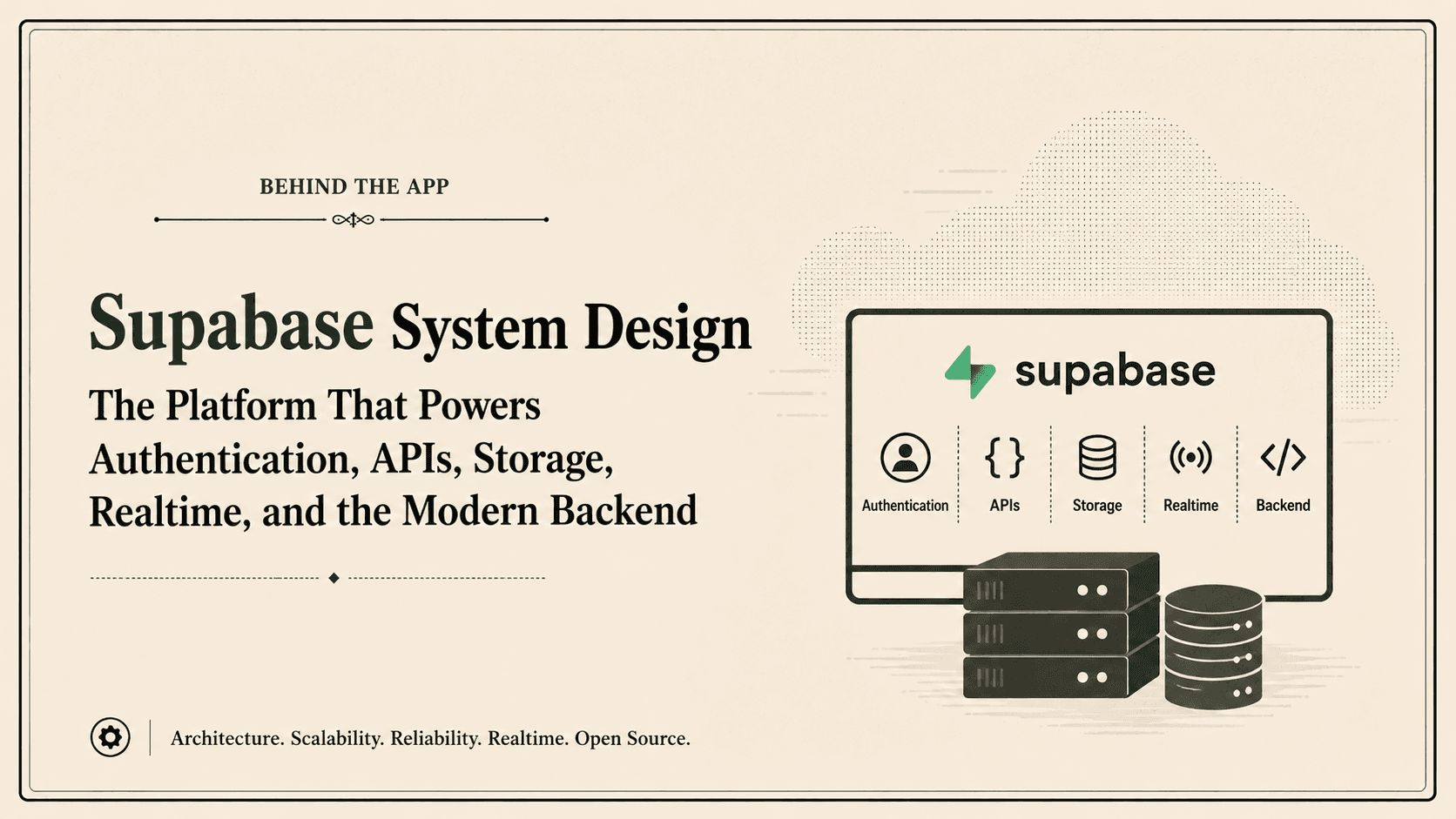
Supabase System Design: The Platform That Powers Authentication, APIs, Storage, Realtime, and the Modern Backend
Supabase stands as a powerful open-source platform that redefines modern backend development by centering on PostgreSQL. It integrates essential services for authentication, APIs, storage, real-time updates, and edge computing while combining relational reliability with tools such as auto-generated APIs, JWT-based auth, global WebSockets, and serverless functions. This architecture ensures scalability, security, and portability for applications of all sizes

AI & ML
How Sora Generates Video: The AI Technology Behind OpenAI's Text-to-Video Model
OpenAI's Sora generates videos using a diffusion transformer (DiT) that processes spacetime patches of compressed latents, enabling coherent outputs with strong 3D consistency and object permanence from text prompts. At its core, the model compresses raw video into a lower-dimensional space via an autoencoder before iteratively denoising noise patches conditioned on detailed text embeddings to simulate realistic motion and world dynamics
Editor's Picks

Architecture
Why Netflix Moved from a Monolith to Microservices: A Comprehensive Analysis of Scalability, Resilience, and Innovation at Global Scale
Read →

Algorithms
Omegle’s Algorithm: Decoding the Technical Magic Behind the Internet’s Most Iconic Random Chat Platform
Read →

Scaling
How Bitly Scaled Technically: The Engineering Story Behind Billions of Redirects and a $100M+ ARR Platform
Read →
Video Feature
▶
Algorithms
Omegle’s Algorithm: Decoding the Technical Magic Behind the Internet’s Most Iconic Random Chat Platform
Omegle’s matching algorithm stood as a model of elegant simplicity combined with practical intelligence. At its core, the system maintained a global waiting queue—implemented as an efficient FIFO structure in memory or backed by high-performance stores—where new users were enqueued upon selecting text or video chat, with a background worker continuously monitoring length and instantly pairing by dequeuing entries and generating a transient session ID.
Watch on YouTube →Get in Touch
Have a question, partnership inquiry, or a specific app you want us to dissect? We'd love to hear from you.
Email: mujahidmahi26@gmail.com
YouTube: youtube.com/@BehindTheApp
Facebook: web.facebook.com/behindtheappg