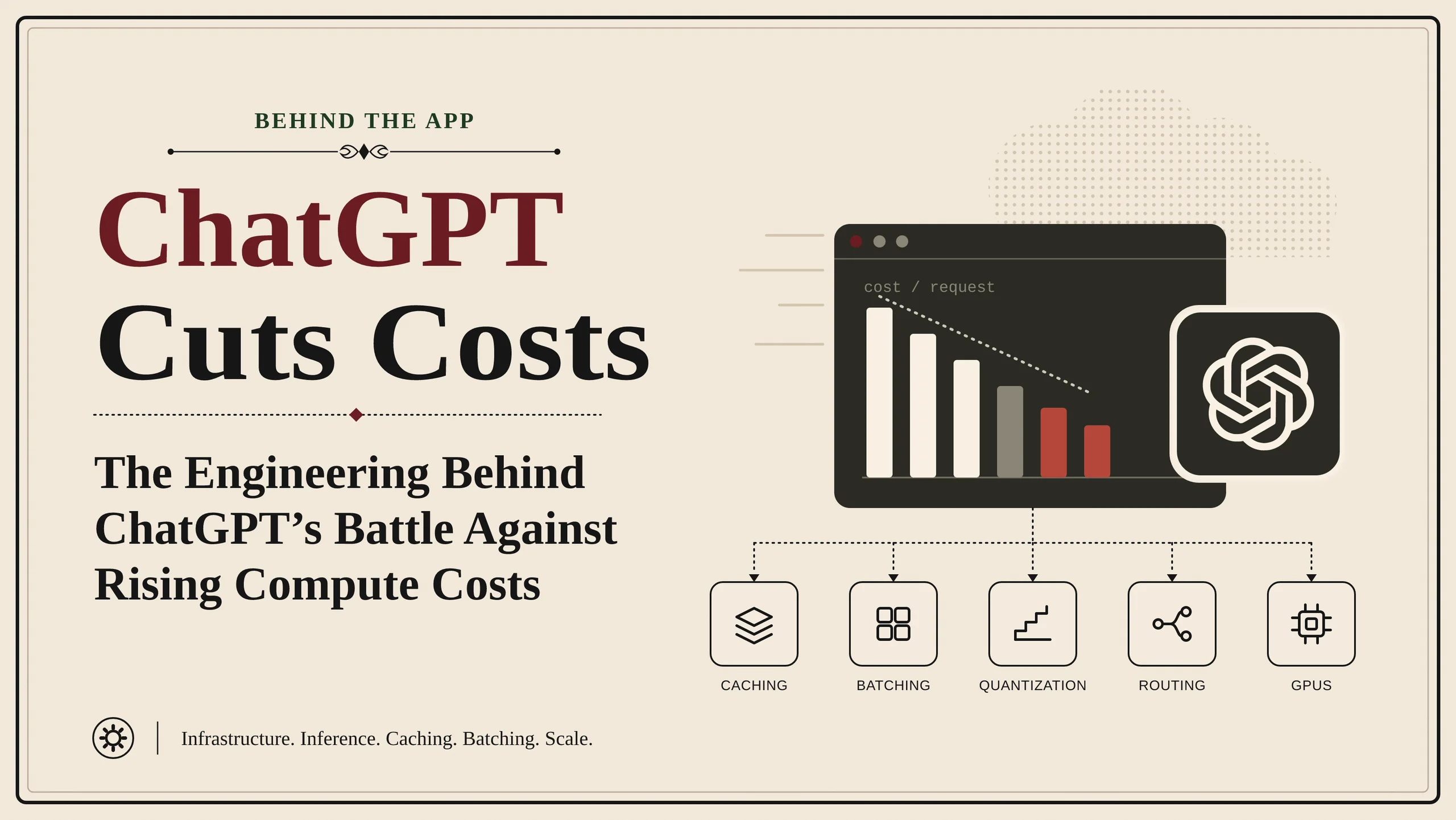
The explosive growth of generative AI, spearheaded by OpenAI's ChatGPT, has thrust the industry into a compute arms race. Training frontier models like GPT-4 and its successors can cost tens to hundreds of millions of dollars in hardware and energy alone. Yet, the real economic pressure—and OpenAI's engineering triumph—lies in inference: the ongoing cost of serving responses to millions of users daily. Inference costs quickly dwarf training expenses at scale, turning what seems like a software marvel into a massive infrastructure challenge.
This article dives deep into the engineering strategies OpenAI employs to tame these costs. Drawing from technical analyses, industry reports, architectural insights, and recent optimizations (including 2026 breakthroughs), we'll explore how mixture-of-experts (MoE) architectures, quantization, KV caching, speculative decoding, advanced serving systems like vLLM-inspired techniques, model routing, and more enable ChatGPT to deliver high-quality responses affordably. We'll examine the numbers, trade-offs, historical evolution, and future outlook, aiming for a thorough understanding of why OpenAI can sustain (and scale) a product that changed the world while battling ballooning compute demands.
The Scale of the Problem: Why Infrastructure Costs Are Existential
To appreciate the optimizations, we must first grasp the scale. Early estimates for serving the initial ChatGPT (powered by a GPT-3.5-like model) suggested around $694,000 per day in compute hardware costs, requiring thousands of A100 GPUs. Each inference request for advanced models could cost $0.03–$0.05 in raw compute, with daily active users pushing aggregate expenses into the millions monthly.
Training GPT-4 reportedly required ~25,000 A100 GPUs for 90–120 days, with compute costs in the $40–100+ million range. Successor models like hypothetical GPT-5 variants have estimates climbing into the billions. But inference is the silent killer: at web scale, even small per-token costs multiply rapidly. Google processes hundreds of thousands of searches per second; deploying LLM-like capabilities naively could erase tens of billions in profit margins.
OpenAI's reported losses (e.g., $8 billion in a year against $3.7 billion in revenue) highlight this. Sam Altman and others have publicly discussed the unsustainable trajectory without breakthroughs. Recent 2026 reports indicate OpenAI achieved >50% inference cost reductions through software optimizations alone, temporarily slashing GPU needs for non-logged-in ChatGPT traffic to just a few hundred Nvidia units. This is a testament to relentless engineering focus.
Key drivers of high costs:
Memory Bandwidth Bottlenecks: Decode phase (token generation) is memory-bound, not compute-bound. Loading full model weights for each token is expensive.
KV Cache Explosion: For long contexts and high concurrency, key-value caches for attention mechanisms consume massive VRAM.
Low Utilization: Static batching leaves GPUs idle waiting for requests to complete.
Model Size: Dense trillion-parameter models are infeasible for real-time serving without sparsity.
Energy and Hardware: GPUs like A100/H100 are power-hungry; data centers face power, cooling, and supply constraints.
OpenAI counters this with a multi-layered stack: smarter architectures, precision reductions, caching/reuse, dynamic scheduling, and hybrid model deployment.
Core Architectural Innovation: Mixture of Experts (MoE)
One of the most impactful decisions was adopting a Mixture of Experts (MoE) architecture, widely believed to underpin GPT-4 (rumored ~1.76 trillion total parameters but activating far fewer per token).
In a dense transformer (like GPT-3's 175B parameters), every parameter activates for every token—computationally prohibitive at scale. MoE introduces sparsity: the model comprises many "expert" sub-networks (e.g., 8 or 16+ specialists, each ~100–220B parameters). A lightweight router (gating network) directs each token to a small subset of experts (e.g., 2 out of 8).
Benefits for Costs:
Inference Efficiency: Only a fraction of parameters (~10–20% or less) compute per token. This keeps active FLOPs manageable even as total parameters grow for better capacity.
Scaling Laws Alignment: Larger total models improve performance without proportional compute increase during inference/training (with proper routing).
Specialization: Experts can implicitly specialize (e.g., one for code, one for reasoning, one for safety), improving quality without uniform activation.
Memory/Throughput Trade-off: Total VRAM footprint is high (all experts must be loadable), but per-token compute and bandwidth demands drop dramatically.
Rumors for GPT-4 suggested ~8 experts of ~220B each. Modern variants push higher expert counts (e.g., 128 with 8 active). This decouples model capacity from inference cost, a key reason ChatGPT remains viable. Without MoE, serving a dense 1T+ parameter model at human reading speeds (~20–30+ tokens/sec) on reasonable hardware would be impossible due to bandwidth limits.
Trade-offs include training complexity (load balancing to prevent expert collapse), routing overhead, and potential quality variance, but OpenAI's implementation (with refinements over iterations) has proven effective.
Precision Engineering: Quantization and Model Compression
Quantization reduces the bit precision of weights, activations, and KV caches, slashing memory bandwidth and storage needs with minimal quality loss.
Weights: Moving from FP16/BF16 to INT8, INT4, or even lower (with techniques like GPTQ, AWQ). This can halve or quarter the memory footprint and boost throughput 2–4x.
KV Cache Quantization: KV tensors (critical for attention) quantized to 8-bit or 4-bit. Since decode is memory-bound, this directly cuts HBM traffic.
Activation/Other: Dynamic quantization during inference.
OpenAI likely employs aggressive post-training quantization and possibly distillation (training smaller student models from larger teachers). Recent optimizations (2026) likely build on this, contributing to the >50% cost cut. Combined with MoE sparsity, effective compute per token plummets.
Real-World Impact: A model quantized to INT8 might run 2x faster with ~50% less power, enabling higher concurrency on the same GPUs. Challenges include calibration to avoid outliers and maintaining long-context coherence.
KV Cache Mastery: The Heart of Efficient Decoding
Autoregressive generation recomputes attention over all prior tokens without optimizations. The KV Cache stores precomputed Key and Value vectors from previous steps, avoiding redundant work.
However, for million-token contexts or high batch sizes, KV cache balloons (gigabytes per request). Optimizations include:
PagedAttention (popularized by vLLM, likely mirrored or improved internally at OpenAI): Treats KV cache like OS virtual memory—allocates in fixed-size pages/blocks on-demand. Eliminates fragmentation and pre-allocation waste, allowing much higher effective batch sizes and concurrency.
Continuous/Iteration-Level Batching: Instead of static batches (where slow requests block the GPU), dynamically add new requests and evict completed ones after each decoding step. This keeps GPUs near 100% utilization. Gains of 2–23x throughput reported in benchmarks.
Prefix Caching / Prompt Caching: Cache shared prefixes (e.g., system prompts, common conversation starters). OpenAI's API supports this with steep discounts (cached tokens ~75–90% cheaper). Ideal for multi-turn chats.
Compression/Eviction: Techniques like SnapKV, StreamingLLM, or merging layers for low-attention tokens. Quantized or offloaded KV.
These turn the decode phase from wasteful to efficient, crucial for ChatGPT's conversational nature.
Speculative Decoding and Parallelization Tricks
Speculative Decoding (or assisted generation) uses a smaller, faster "draft" model to predict multiple future tokens in parallel. The larger target model verifies them in one pass. If accepted (high probability), multiple tokens are generated per forward pass—breaking the sequential autoregressive bottleneck.
Speedups: 1.5–3x or more, depending on acceptance rate.
Variants: Medusa, Lookahead, or tree-based speculation.
Synergizes with quantization (a smaller drafter is cheap).
Combined with FlashAttention (optimized attention kernels reducing memory I/O) and multi-query/grouped-query attention (GQA/MQA, shrinking KV heads), this maximizes hardware efficiency.
Serving Infrastructure: From Custom to Production-Grade
OpenAI runs a massive distributed system:
Model Parallelism: Tensor, pipeline, and expert parallelism across thousands of GPUs.
Disaggregated Serving: Separate prefill (compute-heavy) and decode clusters for better utilization.
Routing and Tiering: Smart routing—simple queries to smaller/cheaper models (e.g., GPT-4o-mini equivalents) and complex to full frontier. Batch API for non-real-time work at discounts.
Hardware Partnerships: Deep integration with Microsoft Azure and custom optimizations for A100/H100 (and beyond). Recent software wins reduce GPU footprint dramatically.
Monitoring and Autoscaling: Dynamic load balancing, fault tolerance, and energy-aware scheduling.
Frameworks like vLLM (open-source but influential) demonstrate these principles; OpenAI's internal stack is likely more advanced, incorporating custom CUDA kernels, graph optimizations, etc.
Prompt Engineering, Caching, and User-Side Optimizations
While backend-focused, frontend efficiencies matter:
Shorter, effective prompts reduce tokens.
Caching repeated interactions.
Output compression or structured responses.
User-tiering (free vs. paid limits).
Enterprise tools emphasize these for 30–60% savings.
Quantifying the Wins: Numbers and Economics
Pre-Optimization: ~28k+ A100s for early ChatGPT.
Post-Optimization: >50% reduction; guest traffic on hundreds of GPUs.
Per-token costs dropped via MoE + quantization to fractions of a cent.
Throughput multipliers from batching/PagedAttention: 5–20x in practice.
Energy savings translate to lower OpEx and better sustainability.
These enable pricing accessibility ($20/month Plus) while scaling to hundreds of millions of users. Without them, ChatGPT would be a niche, expensive tool.
Challenges and Trade-offs
No free lunch:
Quality vs. Efficiency: Aggressive quantization/MoE routing can introduce inconsistencies.
Complexity: Managing experts, speculation acceptance rates, and distributed state is hard.
Hardware Dependency: Still reliant on Nvidia; alternatives (TPUs, custom ASICs) explored.
Diminishing Returns: As contexts lengthen and agents demand more inference-time compute (e.g., O1-style reasoning), new walls emerge.
CapEx: Building data centers (e.g., OpenAI's Georgia project) remains massive.
OpenAI invests in inference-time scaling but balances with efficiency R&D.
Future Directions: Towards Sustainable AI Scale
Looking ahead:
Deeper Sparsity and Hybrid Models: More experts, dynamic routing, and retrieval-augmented generation (RAG) to offload knowledge.
Hardware-Software Co-Design: Custom chips, photonic interconnects, and in-memory compute.
Distillation and Smaller Models: Powerful, specialized models for most tasks.
Edge Inference: On-device for privacy/low-latency.
Algorithmic Breakthroughs: Better than transformers? Test-time compute optimization.
Sustainability: Renewable energy, liquid cooling, utilization >90%.
OpenAI's 2026 optimizations signal software can still deliver big wins before next-gen hardware. Competitors (Anthropic, Google and xAI) pursue similar paths, accelerating the field.
Conclusion: Engineering as the Moat
ChatGPT's success isn't just better models—it's world-class systems engineering that makes intelligence affordable at a planetary scale. By combining MoE sparsity, quantization, sophisticated caching and batching, speculative techniques, and intelligent orchestration, OpenAI battles rising compute costs head-on. This infrastructure stack turns theoretical capability into a daily tool for millions while keeping economics viable amid exponential demand.
The battle continues: inference efficiency is now the primary competitive arena. As AI integrates deeper into search, agents, coding, and enterprise, these optimizations will determine winners. OpenAI's approach—iterative, data-driven, hardware-aware—offers lessons for the industry: scale smart, not just big.
Did you enjoy this dissection?
Discussion (0)
No comments yet. Be the first to start the engineering discussion!